8
Morphs, Mutations, and Notes on Genetics
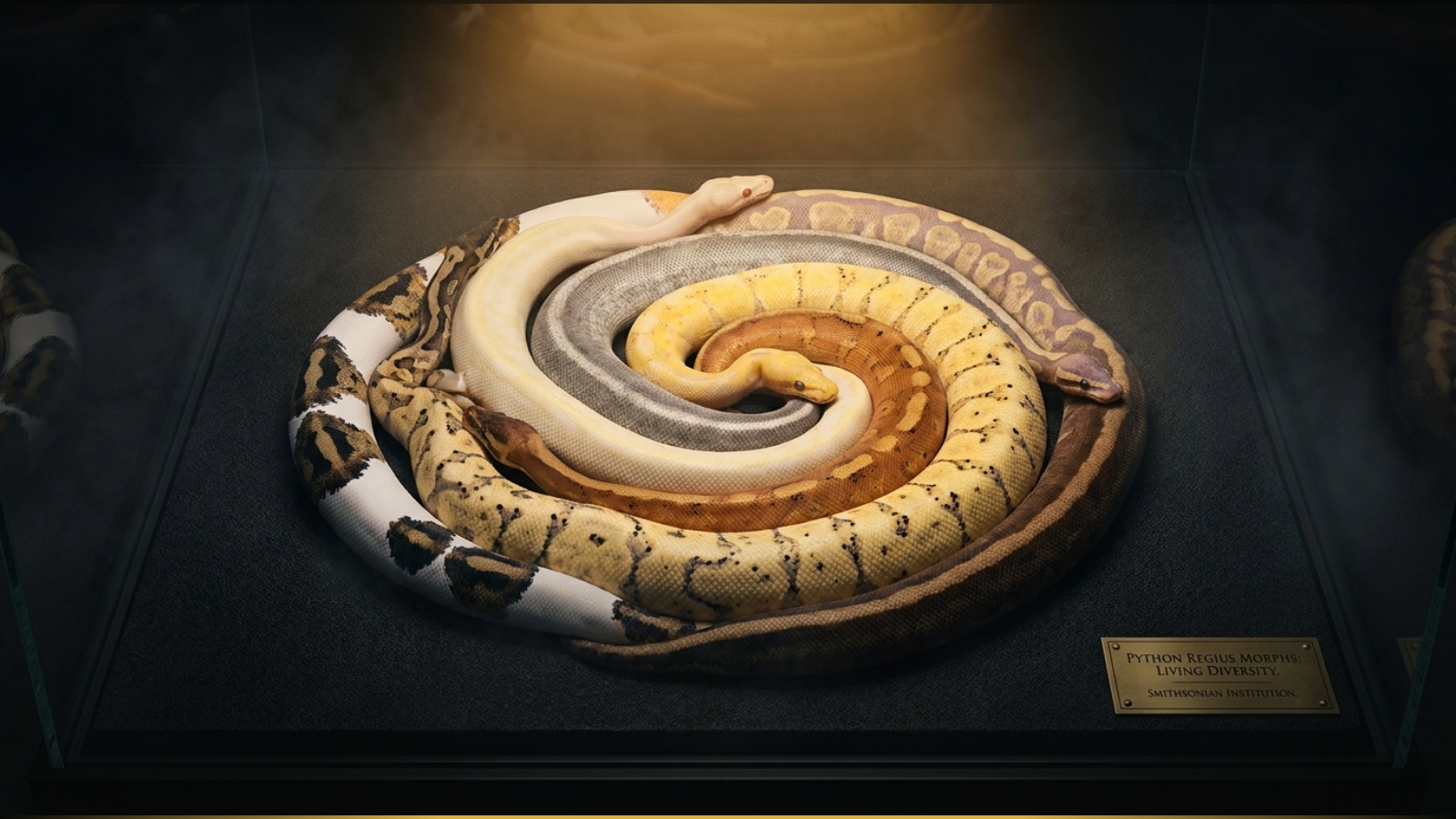
The ball python morph market is the largest and most active reptile-genetics market in the world. There are over 6,000 documented morph combinations. Some are gorgeous, some are common, some are rare, and a small number carry welfare concerns serious enough that we have an opinion about them.
Morphs do not change husbandry. A snow-white pied ball python needs the same care as a wild-type. They affect price, breeding goals, lighting sensitivity in some cases, and — in a small number of mutations — the animal's health.
Inheritance basics — how morphs are passed down
| Inheritance type | How it works | Common ball python examples |
|---|---|---|
| Dominant | One copy shows the trait. Two copies look the same as one (no “super” form). | Pinstripe, Spider |
| Co-dominant / incomplete dominant | One copy shows partially. Two copies make a different-looking “super” form. | Pastel (super pastel = very light), Mojave (super mojave = blue-eyed leucistic), Enchi |
| Recessive | Needs two copies to show. Carriers (“hets”) look normal but can pass the gene. | Albino, Piebald, Clown, Ghost, Lavender Albino, Genetic Stripe |
| Lethal in homozygous form | Two copies cause death of the embryo or hatchling. Cannot be made into a super. | Super Cinnamon (cinnamon × cinnamon), Super Black Pastel, Super Champagne (typically lethal) |
| Polygenic / line-bred | Multiple genes influence the look. Selectively bred over generations. | Hypo lines, line-bred reduced-pattern animals |
Going deeper — alleles, complexes, and epistasis
The table above covers how a single gene is inherited. The reason the morph world looks so complicated is that genes also interact — with their own variants, and with each other. Three ideas explain most of the surprises.
The rest of this chapter is in the full guide
Unlock The Ball Python Codex
You're reading the free preview. Unlock once and the entire book opens — every chapter, every section. 42 more sections are waiting in this chapter alone.
- Full husbandry: enclosure, heat & humidity, feeding, handling
- Health, parasites, and when to see a vet
- Morphs, genetics, and notable breeders
- Every appendix, glossary, and quick-reference card
What we guarantee: you will finish this understanding that there is more than one right way to keep a ball python, and knowing the reasoning under each one. You will ask sharper questions and notice things in your own animal you used to walk past.
One-time purchase · secure checkout by Gumroad