6
Enclosure and Setup
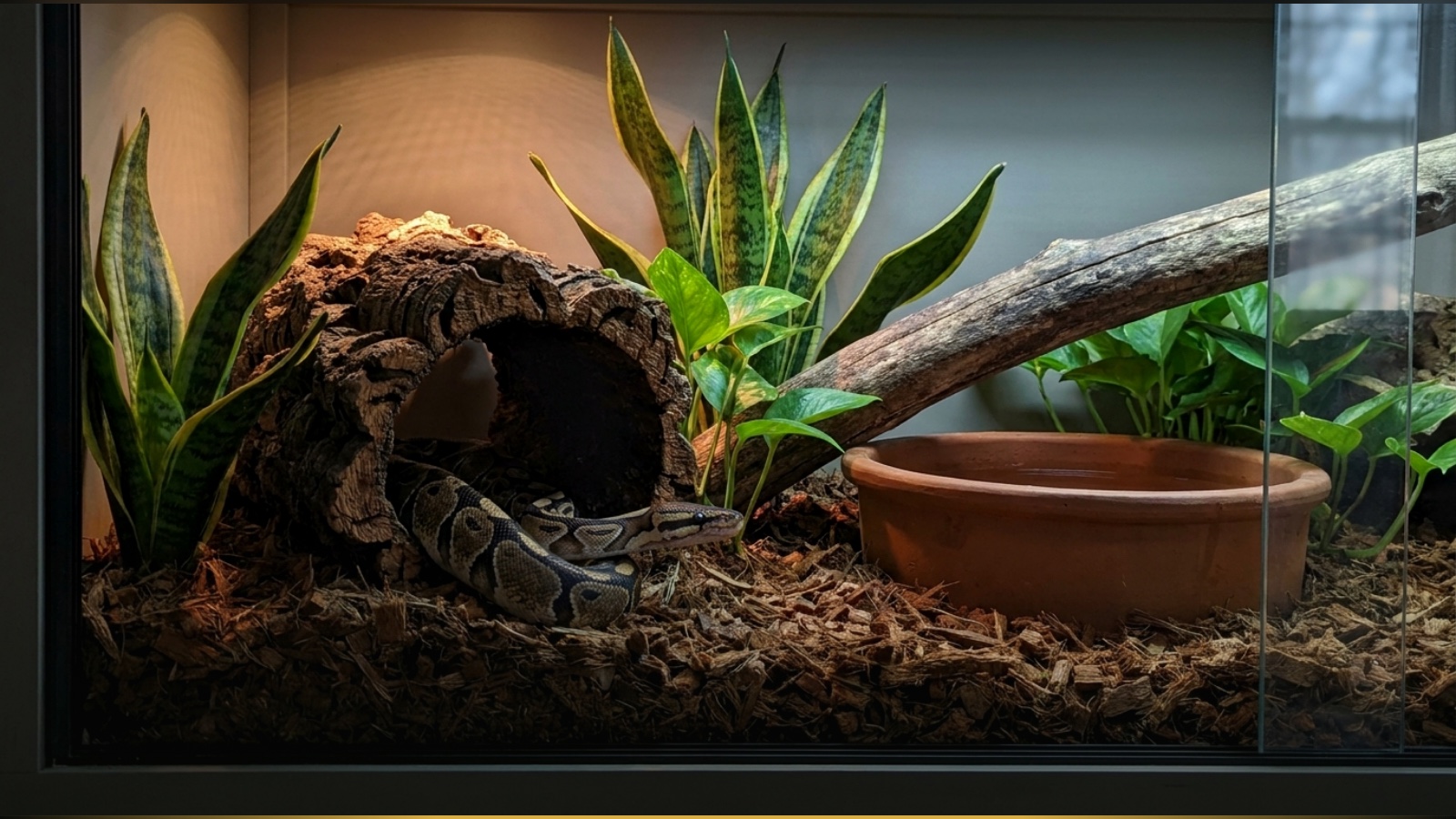
There is no single best enclosure for a ball python. There is the enclosure that fits the animal, your home, your climate, your skill level, and your budget. We will lay out the options honestly and tell you what works for which keeper.
Cage size — what actually works
A 40-gallon (or equivalent) enclosure is an acceptable minimum standard for an adult ball python kept well. A 4 ft by 2 ft by 2 ft (120 × 60 × 60 cm) enclosure is the ideal — more room, more clutter, more thermoregulation choice for the animal. Both work. If you are reading this with a 40-gallon already set up, you are not behind the curve. If you are building toward the 4×2×2, you are giving the animal more of a good thing.
Adult males and adult females use the same recommended sizing. Females generally reach the larger end of the species' size range, but the difference is not large enough to warrant a separate spec — both sexes are well served by the same enclosure footprint.
Some shy adults do thrive in smaller, more cluttered setups, and some excellent breeders maintain large adult collections in tubs. The animal will use the space if you fill it with cover. The keepers who get this wrong are the ones who put a snake in a big bare cage and conclude that ball pythons are stressed by space — what stressed it was the absence of cover, not the volume.
| Hatchling (under 300 g) | 10–20 gallon tank or 6–12 qt tub. Smaller and more secure is genuinely better at this size. |
| Juvenile (300–1,000 g) | 20–40 gallon equivalent, or 28–41 qt tub, or 36" × 18" × 18" enclosure |
| Subadult (1,000–1,500 g) | 36" × 18" × 18" or larger |
| Adult (any sex) | 40-gallon equivalent (acceptable minimum) or 4 ft × 2 ft × 2 ft (ideal), with full clutter. Larger footprints are welcome — the snake will use them when there is cover. |
Enclosure types — honest pros, cons, and who they are for
Glass enclosures (aquariums and front-opening glass terrariums)
- Pros: visibility, lower cost of entry for the right size, widely available, good heat dissipation makes a temperature gradient easier to set up.
- Cons: screen tops dump humidity (you will fight humidity in dry climates), heavier than PVC at equivalent size, more fragile, the snake may feel exposed without coverage on three to four sides.
- Best for: display-focused keepers, beginners on a budget, anyone in a humid climate, anyone willing to cover three to four walls with construction paper or vinyl to give the snake visual security.
PVC enclosures
- Pros: holds heat and humidity well, lightweight, stackable, durable, opaque on three sides which most ball pythons appreciate, front-opening design is easier and less stressful for the snake.
- Cons: higher upfront cost (often $300–1,000+ for a 4×2×2), less visible from the side.
- Best for: any keeper who wants strong heat and humidity retention, anyone in a dry climate, anyone planning to keep more than one snake long-term, anyone whose room runs cool. PVC is the default recommendation across experience levels — there is nothing harder about running one than running a glass tank well.
Racks and tubs
- Pros: efficient for collections, very stable thermal and humidity environment, low stress for shy feeders (and ball pythons are famously shy feeders), space-efficient.
- Cons: not display setups, require active climate control across the whole room or rack, controversial in public-facing parts of the hobby.
- Best for: breeders, serious keepers managing multiple animals, anyone with a problem feeder who needs the security of a tub to get the animal eating reliably.
- Experience framing: we recommend racks for intermediate keepers and up — because there is more to manage in a rack system (room-wide ambient, heat tape behavior, ventilation, multi-tub monitoring), not because beginners are incapable. A beginner who does their homework, monitors diligently, and understands the system can absolutely run racks well. The recommendation is about preparedness, not gatekeeping.
Wood and DIY enclosures
- Pros: customizable, often beautiful, well-suited to bioactive setups, holds heat extremely well, lets you build to a footprint that does not exist in commercial PVC.
- Cons: must be sealed properly (multiple coats of food-safe sealant, marine-grade polyurethane, or similar) or moisture will destroy them. Harder to fully disinfect. Heavy.
- Best for: keepers who want a display piece or a bioactive build and have either the woodworking skill or the budget to commission one.
- If you build your own: use cabinet-grade plywood or melamine, seal with at least two coats of marine-grade polyurethane or epoxy, let it cure fully (at least one to two weeks with airflow), and verify zero off-gassing before introducing the animal. Culebra Connect has a build-along thread with photos and material lists.
Temperature and the meaning of “range”
A temperature range is a target window, not a single dial setting. The animal thermoregulates by moving — hot side, cool side, hide. Your job is to make both sides correct most of the time, not to nail a single number.
| Hot side / basking surface | 88–92°F (31–33°C). Measured by surface thermometer or temp gun at the warm hide floor or basking spot, not the air temperature. |
| Hot side ambient air | 82–86°F (28–30°C) |
| Cool side ambient air | 65–72°F (18–22°C), depending on your room temperature and basking strength. Hotter basking surfaces and warmer rooms let the cool side run at the lower end; cooler rooms or weaker basking should keep the cool side closer to 72°F. The animal still needs a hot side to retreat to — a 65°F cool side only works when the hot side is solid. |
| Nighttime drop | A few degrees is acceptable and arguably beneficial. The cool-side range above already accommodates a natural night drop. |
The rest of this chapter is in the full guide
Unlock The Ball Python — Complete Care Guide
You're reading the free preview. Unlock once and the entire book opens — every chapter, every section. 40 more sections are waiting in this chapter alone.
- Full husbandry: enclosure, heat & humidity, feeding, handling
- Health, parasites, and when to see a vet
- Morphs, genetics, and notable breeders
- Every appendix, glossary, and quick-reference card
One-time purchase · secure checkout by Gumroad
